I am holding a wooden ball at the Gaylord National Resort & Convention Center. It is approximately 3:13 PM. We took a rideshare Hyundai Elantra here from our hotel, about fifteen dollars and some odd cents, because our friends kept the rented Honda Odyssey (they were tired from the night before and wanted a slower afternoon, so we let them have the van while we went ahead to National Harbor). It is raining lightly outside. I do not know this yet, but I will be standing at this machine for the next seven hours.
The arcade hall is windowless, maybe 400 square feet, packed with about 400 machines. Most of them are imported rhythm games, niche cabinets with Japanese text and blinking prompts, and they appeal to me, but I have not moved from this spot. I am standing behind one of three Skee-Ball machines, a wooden ball in my hand, and I am trying to decide how hard to throw it. Two of the machines look like they are from a bowling alley in the 1990s with their cool-toned, slick surfaces, vaguely neon backlighting, block letter font that reads "Skee King" by "ArcadeSolutions," a phrase that suggests that there was once a niche arcade distributor that specialized in these kinds of games. The third machine looks like it is from the 70s: brown on brown on brown details, acacia paneling, and a cursive font that could have fit at home on the cover of a B-side funk record. Both these machines are beaten up, and have probably been serviced hundreds if not thousands of times. The balls have likely made contact with the microbiome of maybe hundreds of thousands of children. The bacterial lineage that has taken refuge on these balls may have spanned decades of microbial life with different profiles of antibiotic resistance, plasmid genomes, and dominant species. Some fungal species may have existed on those balls as well. New species of bacteria may have even taken hold on the surface of those tiny wooden orbs. I say this, because they have likely never been cleaned in their 30-50 years of existence. Or maybe they have and I am just overly cautious around any device that makes contact with children.
I think of the Skee-Ball machine repair guy, who's full name may be something like Thomas MacArthur, but likely goes by "Mac" or "Tom," and it is written in red cursive on a white oval badge that adorns his 100% cotton heavy knit workwear shirt. He never goes by Tommy; it is too childish, too goofy. Maybe his mother calls him Tommy, but nobody else. Mac is here to work. He takes his business very seriously. He inherited it while working an odd job as an assistant to the original owner ("Robert 'Bob' Kingsley"), who also managed several other niche appliance repair companies, but put most of his effort into the Skee-Ball repair business as it was his passion project, and he was maybe regarded as the best Skee-Ball repair technician in North America. Mac took this job shamefully after dodging the draft in Vietnam at the age of conscription—and as such, found himself socially ostracized and minimally employable. He struggled with alcoholism at the time, and often showed up to work two whiskeys in. Little did he know Bob's business would be equally as militant. After a near death experience with a specific electrical device the company used to calibrate the scoring mechanism on the machines, Mac would later turn a new leaf. He sobered up, started paying attention, and eventually took on the tools of the trade himself. He too would retire, probably around 1994.
His lineage would not be succeeded. Instead, staffing agencies would hire temp workers who specialized (if we can call it that) in the repair of a suite of different machines as part of pre-fabricated arcade packages contracted to various bowling alleys, casinos and boardwalks by regional conglomerates that would in twenty or thirty years be merged and acquired by private equity and replaced with digital approximations of Skee-Ball (touch-free, enhanced, cleaner, safer, lower maintenance costs, which is to say: no wood, no ball, no lane, just a screen you tap and a digital arc toward digital scoring rings and digital tickets redeemable for nothing). Mac doesn't exist anymore, is what I'm saying. Whoever services these machines now is some temp or contract employee who wears a quarter-zip with the company logo and khaki joggers that bunch unflatteringly at the ankle, and who mostly hits his weed vape in the parking lot between service calls. He drives a white panel van with the company logo magnetized to the side—removable, because the van is leased and will be returned at the end of his contract, which renews every six months if he's lucky. He has never read the 53-page service manual. He has a diagnostic app on his phone that tells him which part to replace, and if the app is wrong, he calls his supervisor, who also has not read the 53-page service manual but will pull it up on his laptop in the office and read aloud from the troubleshooting guide while the contract worker stands in the arcade holding a 9/16" wrench he had to quickly buy from the nearby hardware store because he didn't bring the right tools.
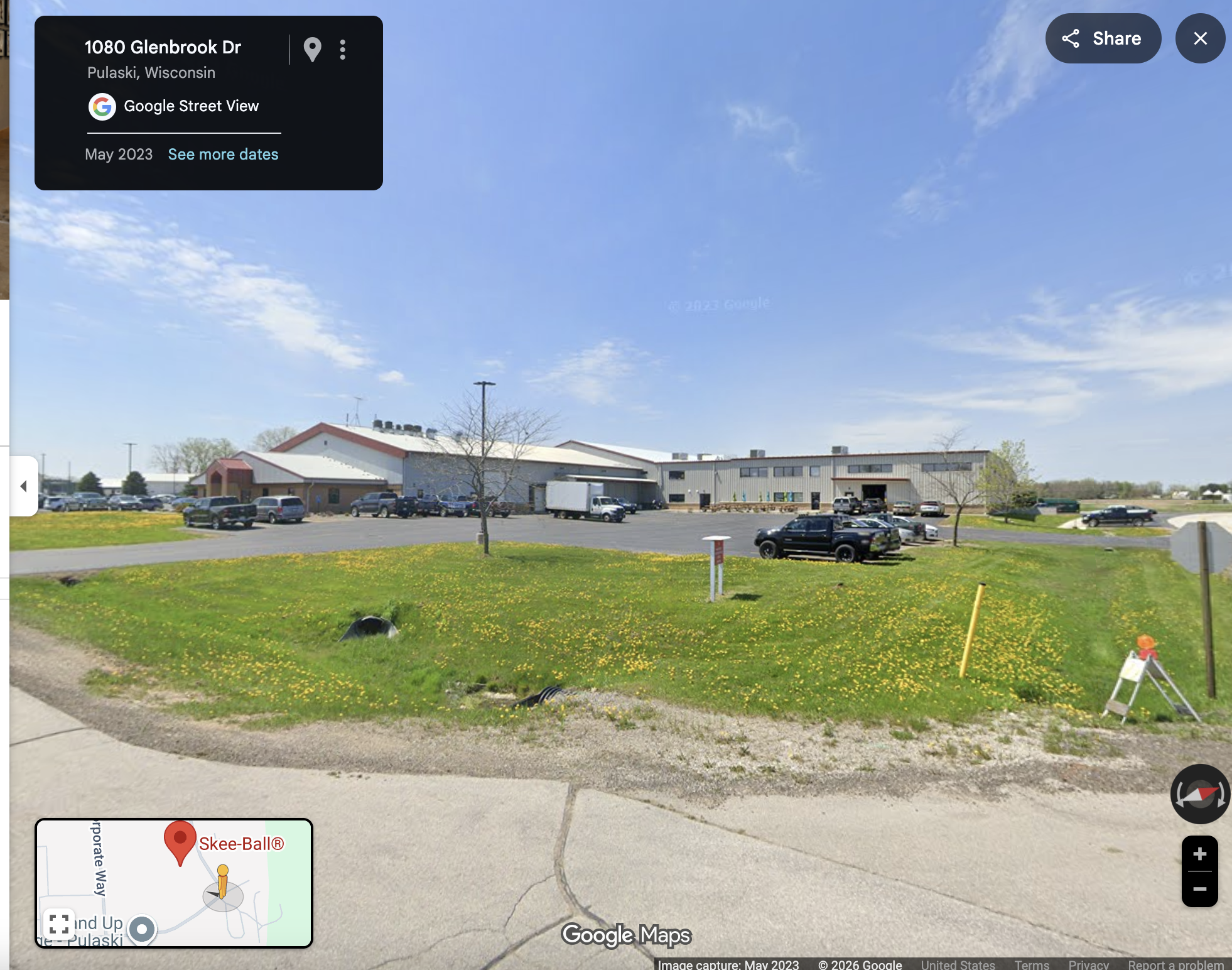
Nobody knows where the manager's office is. It likely exists in a business park in the suburbs of Wisconsin, or perhaps in an inconsequential quasi-industrial suburb of California like La Habra or Ontario. The office is located in the kind of place where strip malls anchor the main thoroughfares, and the restaurants are chains you've heard of but would never seek out. The hours are probably Monday through Friday, 8 AM to 5 PM CST, and the street leading to it probably has a name like "Industrial Park Way." The manager wears ill-fitting spandex-cotton blend chinos with white-bottomed shoes (the kind that are sold as "business casual" but read as neither business nor casual) and maybe a polo shirt, or a hoodie if it's Friday, or the same quarter-zip pullover with the company logo embroidered in a thread color that doesn't quite match the background fabric as his underlings. They have never met Mac. They do not know that Mac existed. They know only that there is a 53-page service manual and a network of distributors (AVS Companies, Betson, Central Distributing, Moss Distributing, Player One Amusement Group, Shaffer Distributing) and a Customer Solutions Team reachable at (920) 822-3951 Ext 1102 or service@baytekent.com.
Mac would have known with his hands. Mac would have run his palm along the lane and felt where the wood had warped over thirty years of use. Mac understood the machine not as a collection of discrete components with part numbers (AACE18006: Sensor & Motor Power from Head Cable; AACB3850A: Ball Track Sensor; AAMB18000-SBG: Mother Board) but as a single continuous thing, a system that had accumulated a history legible only to someone who had been paying attention.
The game itself was patented in 1908 by a man named Joseph Fourestier Simpson, who lived in Vineland, New Jersey, a town whose name sounds generated by an algorithm designed to produce plausible-sounding but ultimately forgettable American place names. Simpson was a serial inventor in the way that certain men of that era were serial inventors: he tinkered and patented and hoped that one of his contraptions would transform him from a man who fiddled with things in his shed into a man of means. None of his other inventions brought him fame or riches. This one, eventually, would bring him neither as well, but it would outlive him by more than a century. Simpson would have done his own repairs. This is obvious but worth stating, because in 1909, when he and his licensing partners created the Skee-Ball Alley Company, there was no distinction between the man who invented the thing and the man who fixed the thing. The original alleys were thirty-two feet long, and you had to throw the ball with some force, like you were hurling something at someone you were angry at, but in a controlled and socially acceptable manner. The jump was in the middle of the lane back then, shaped like a miniature ski ramp, which is where the name comes from: skee, a deliberate misspelling to evoke the alpine sport. There were lawsuits in the 1930s after the wooden balls broke free and caused bodily harm to people in the saloon.
I really wish we were in a saloon right now.
Simpson ran out of money almost immediately, and by 1913 a man named Jonathan Dickinson Este had acquired all rights to the game. Este was a shrewd marketer, something Simpson had not been, and until recently Este was actually credited as the game's inventor, because Simpson had been so thoroughly erased from the historical record that even the history of the thing he made didn't include him. By 1935 the Wurlitzer company owned it, and discovered that this simple game outsold their own jukeboxes, which must have produced a specific kind of institutional confusion. In 1945 the Philadelphia Toboggan Company acquired the rights. In 1967 the automatic ticket dispenser was added, transforming the game from a skill-based amusement into a redemption game, which is to say a gambling apparatus for children. In 1985 a businessman named Joe Sladek obtained the rights. In 2016 the game was purchased by Bay-Tek Entertainment of Pulaski, Wisconsin, population 3,500, who also own the rights to Super Shot (the basketball game you've seen at every Dave & Buster's) and, inexplicably, Flappy Bird, the mobile game that consumed approximately six months of collective human attention in 2014 before its creator pulled it from app stores in what he described as an act of conscience. If you go to Bay-Tek's website looking for Flappy Bird parts (and I do not know what a Flappy Bird part would be, I do not know what it would mean to keep a Flappy Bird game running) you will find a message directing you to their Customer Solutions Team, who "may be able to help arrange special order parts or find alternative solutions."
Mac would have started working on these machines sometime in the early 1970s, which means he would have seen the transition from the 14-foot alleys to the 10-foot alleys, would have installed the first automatic ticket dispensers, would have watched the game transform from something you played for the pleasure of playing into something you played to accumulate tickets redeemable for prizes of decreasing quality. He would have understood, in a way that the contract worker with his diagnostic app cannot understand, what was lost in each of these transitions.
The child, before it has language, before it has a coherent sense of self and other, derives pleasure from the mastery of objects. This is the first real power any of us ever has: not social power, not the power to speak or persuade or manipulate, but the fact that your arm can move a thing through space and the thing will go where you sent it. The ball leaves your hand at a certain angle with a certain force, and the result is knowable. Play is the space of immediacy, the one place where abstraction fails, where mediation becomes loss rather than gain. The ball is wood. The lane is wood. The jump is wood. The scoring rings are wood and metal. There is no software interpreting your input, no algorithm deciding whether your throw was good enough, no simulated physics. The machine cannot cheat you, or if it does, you can at least understand how it's cheating you. You could see the warped lane, or the worn jump, or the ball that has been rolled so many thousands of times that it is no longer perfectly spherical. These are faults Mac could perceive and adjust for, faults that exist in the accumulated history of the object itself. Wood, as a material, resists digitization: it warps, it wears, it remembers. A wooden Skee-Ball lane that has been played on for fifty years is different from a new wooden Skee-Ball lane in ways that matter. The digital screen forgets everything the moment you close the app.
I roll my first ball. It veers slightly left. The lane is warped, or perhaps my technique is off, or perhaps both. The ball drops into the 20-point ring. There is a moment, after the ball leaves your hand but before it lands, when you do not yet know the outcome. This is the moment the screen cannot replicate. Your arm learns. Your arm remembers. The diagnostic app or the simulated physics cannot know what your arm knows.
I adjust, roll again. This one goes straighter, hits the jump at a better angle, arcs toward the 40. It lands in the 30. Close. I have seven balls remaining. Outside, it is still raining. Inside, the arcade machines flash and beep, their various sounds blending into a kind of ambient hum. This is MAGfest (Music and Games Festival, formerly the Mid-Atlantic Gaming Festival) and I have been here for hours. I have played probably fifty or sixty sessions. I have waited in line between each one, sometimes up to twenty minutes at a stretch, standing behind strangers who are standing behind strangers, because the line for the Skee-Ball machines is fifteen people deep at 2:30 in the morning and I keep getting back in it.
There are four hundred machines in this building. Rhythm games where you tap in sequence. Fighting games where you input combos. Racing games where you turn a plastic wheel. Retro consoles running ROMs of everything I grew up playing and everything I didn't. I have played almost none of them today. I am standing in front of the wooden box with the ramp, and I cannot stop.
What MAGfest gets right, maybe without even trying, is that it doesn't separate any of this. The Skee-Ball machine sits ten feet from a Dance Dance Revolution cabinet and neither one is the nostalgia exhibit. There is no velvet rope around the old stuff, no placard reading GAMES OF YESTERYEAR. They are all just games: the 1970s acacia-paneled lane and the imported Japanese rhythm box with its seizure-inducing LED array are part of the same continuum, the same impulse, the same lineage. And the line for Skee-Ball is not a line of people mourning what was lost. It is a line of people who have spent the whole weekend playing Tekken and Beatmania and whatever else, and who are now waiting for their turn at the thing that started all of it.
Ball in hole. This is the archetypal form, the primitive recurrence that shows up everywhere once you start looking: pachinko, pinball, billiards, golf, basketball, beer pong, those coin pusher machines at the boardwalk, the gacha capsule dropping into the chute. But the archetype is not really the ball or the hole. It's the arc: the commitment to a motion whose outcome you do not yet know, and then the outcome. The combo in a fighting game has this: you input the string and for a few frames you are committed, you are in the air, and it will connect or it won't. The rhythm game has this: you hear the phrase building and your hands chase it to its resolution. The RPG has this, stretched across forty hours with a lengthy arc toward a conclusion that you have been assured is coming but cannot verify until it arrives. Ball in hole is just the version with nothing else attached. The satisfaction is pre-cultural, pre-linguistic, maybe even pre-human: the completion of an arc, the thing arriving where you intended it to arrive, the hole that wants to be filled and the ball that fills it. Everything else is elaboration. The games on the screens around me are elaborations so complex they have sometimes forgotten what they are elaborating on, but Skee-Ball has not forgotten. Skee-Ball is the arc, naked, with a ramp and a points system and that's it. That's the whole thing.
I am not saying is that the screen ruined the game. The screen is fine, beautiful even. What I am saying is that the arc itself was tampered with. There was a time when mastery and chance existed in a kind of erotic tension with one another where you practiced, you improved, and still the ball might catch a seam in the lane you hadn't noticed, and the pleasure was precisely in this negotiation, this ongoing conversation between what you could control and what you could not. That dialectic has been abolished. What replaced it is a toggle switch: you are either grinding or you are gambling, and there is no third position. The lootbox and the leaderboard are the same thing viewed from two angles of the same flattened plane where beneath is a condition in which trying hard at something begins to feel liturgical, ceremonial, a gesture performed because the gesture itself is all that remains of a world in which gestures once produced results. The meta, the patchnotes, and the version number are the game now.
In Skee Ball the arm learns. You develop a release point, a preferred angle, a sense for how much force the jump wants. This is mastery. Sometimes the ball drifts left for no reason you can identify. Sometimes it is the lane. Sometimes it is the ball, which has been rolled ten thousand times and is no longer the shape it was when it left the factory. Sometimes you have accounted for every variable you can perceive and some irreducible remainder takes over anyway and the ball drops into the 10, or skips the scoring rings entirely and sails off the back of the machine, or launches off the jump at an angle that defies your understanding of what just occurred, clears the hood, bounces off the ceiling, and rolls back down the lane toward you like a dog returning a stick. That is the chance**. Skee-Ball is the dialectic.
I roll my seventh ball. It lands in the 40. My arm is learning. I will get back in line. Somewhere in the Pulaski Industrial Park, a spreadsheet is updated.
**Bowling solved this through the establishment of the Professional Bowling Association, which made sure the lanes were perfectly oiled, the pins were cut to specification, and the lanes were perfectly maintained. Nobody has seriously "gone pro" in Skee-Ball.